Your siding does far more than make your home look good. Along with your roof and gutters, it is one of the main defenses against Tennessee's rain, wind, humidity and summer heat. But siding does not last forever, and a handful of common siding problems can shorten its life or let water into the walls long before you notice. Here is how siding protects your home, what damages it and the warning signs to watch for.
How siding protects your home
Siding works as part of a system. The panels or boards shed most rain away from the house, while the water-resistive barrier and flashing behind them stop the water that gets past. Together they keep the wall framing dry and help prevent rot, mold and mildew.
Siding also takes the brunt of wind, wind-driven rain and hail so the structure behind it does not have to. And insulated siding adds a layer of foam to the exterior walls, which can make the house more comfortable and help with heating and cooling bills. Siding can only do these jobs when it is in good condition. These are the problems that most often get in the way.
Pests
Wood siding is the most vulnerable, from woodpeckers looking for insects to carpenter bees boring nesting tunnels. Termites can work through wood until boards are badly weakened. Watch for small round holes, little piles of sawdust, and boards that sound hollow when tapped. Termites call for a professional pest control service before any siding work. If pests keep coming back, fiber cement or vinyl siding does not draw them the way wood does.
Moisture and warping
If your siding has started to buckle, bow or pull away from the house, it is warped. With vinyl, warping is most often an installation problem: vinyl expands and contracts with the temperature, and panels that were nailed too tightly or butted hard against trim have no room to move. The installation manual from Polymeric Exteriors, formerly the Vinyl Siding Institute, calls for a small gap under every nail head for exactly this reason. Intense reflected heat, from a grill set too close or a nearby window, can also distort vinyl.
Warped siding is more than a looks problem. The gaps it opens let wind-driven rain and air behind the panels, and that moisture can soak the sheathing and show up inside as stains, peeling paint or a musty smell. The EPA's guide to mold and moisture in your home explains why it is worth acting quickly. Have warped siding looked at as soon as you notice it.
Storm damage
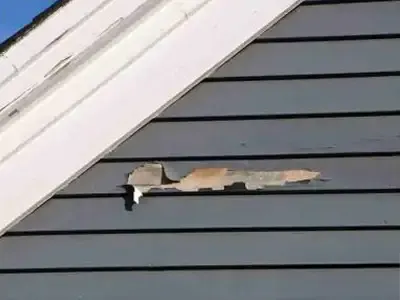
Hail and wind can crack, chip or puncture vinyl siding, dent aluminum, and pop panels loose or tear them off. Siding damage is easy to overlook after a storm, especially when the roof is damaged too and gets all the attention. After a major storm, walk around the house and check every wall along with the roof. If you find damage, our page on storm damage roof repair covers what happens next, and our post on how storms damage both roofing and siding explains why it pays to have both looked at together for the insurance claim.
Poor installation
Along with a lack of maintenance, poor installation causes more siding problems than anything else. Siding that rattles in the wind or makes loud popping sounds as the temperature changes usually was not installed properly. Missing flashing around windows and doors, a skipped water-resistive barrier and a crooked starter course all show up later as leaks and waves in the wall. To avoid problems from the start, hire an experienced siding contractor with a strong local reputation and read their reviews before you sign. Our post on why siding installation is not a DIY job covers the most common mistakes.
Warning signs of common siding problems
- Warped, buckled or bowing panels
- Cracks, chips, dents or holes
- Round holes, sawdust or other signs of pests
- Soft spots, rot, mold or mildew
- Bubbles or blisters on the surface, which can mean trapped moisture
- Gaps at seams, corners or around window and door trim
- Rattling or popping noises in wind or as the temperature changes
- Rising energy bills with no other explanation
- Peeling paint, bubbling wallpaper or damp spots on interior walls
Repair or replace?
Not every problem means new siding. A few cracked or loose panels, a dented section after a storm or one rotted board can usually be repaired. When warping, rot or damage shows up across several walls, or when the siding is old and faded enough that replacement pieces will never match, replacing it is usually the better investment. Either way, the cause has to be fixed too, whether that is an overflowing gutter, missing flashing or tight nailing, or the new siding will have the same problem.
Keep your siding in good condition with Mobley Brothers
Mobley Brothers Roofing & Renovation provides siding repair and installation for vinyl, wood and fiber cement siding, along with roofs and gutters, throughout Middle and East Tennessee. We find the real problem, show you photos of it and put the scope in writing. Both offices are A+ rated by the Better Business Bureau. Call our Lebanon office at (615) 455-3131 for Middle Tennessee or our Knoxville office at (865) 205-0800 for East Tennessee, or send us a request for a free estimate.
Request a free estimate
A few details help us send the right person. If water is coming in right now, call instead.